
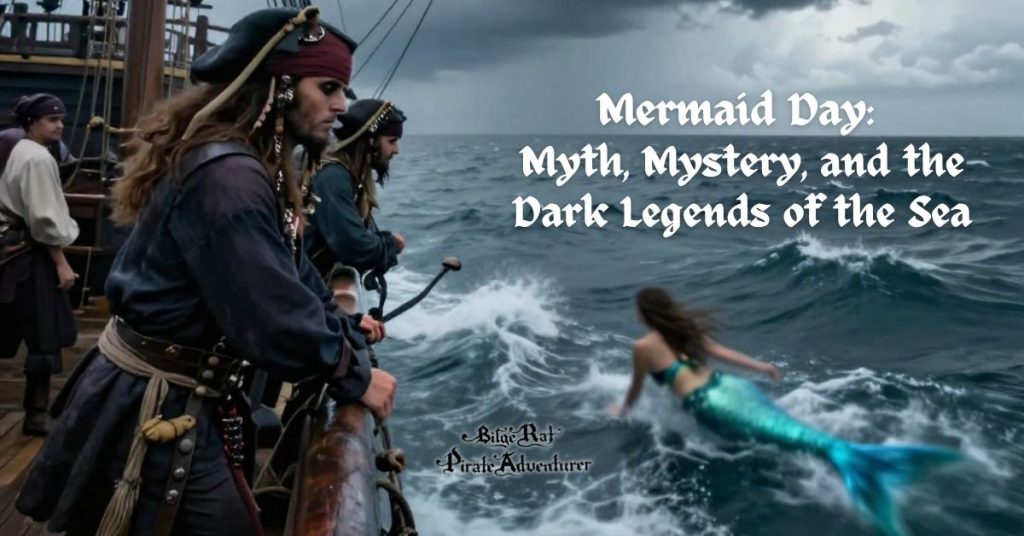
Exploring mermaid mythology, pirate superstitions, and the truth behind ocean legends
There are few legends as enduring—or as unsettling—as the stories of mermaids.
For centuries, sailors have told tales of mysterious figures rising from the sea. Half human. Half creature. Beautiful… or deadly. Guides… or destroyers.
On Mermaid Day, these beings are often remembered as enchanting symbols of the ocean’s beauty. But for those who lived and sailed during the Golden Age of Piracy, mermaids were not harmless myths.
They were warnings.
In the long history of mermaid mythology, these creatures represented the unknown depths of the ocean—the part of the world no sailor could truly understand or control. Within pirate legends and sea folklore, mermaids were not just stories—they were part of a belief system shaped by isolation, danger, and survival at sea.
Where the Legend Began: The Origins of Mermaid Mythology
The origins of mermaid mythology stretch back thousands of years, making it one of the most widespread and enduring ocean myths in human history.
Ancient cultures described beings that lived between land and sea:
- The Assyrian goddess Atargatis was said to transform into a fish-like form
- Greek mythology introduced the Sirens—often confused with mermaids—who lured sailors to their deaths
- European folklore later blended beauty and danger into the mermaid figure we recognize today
By the time sailors were navigating the Caribbean during the Golden Age of Piracy in the early 1700s, these stories had evolved into deeply rooted maritime beliefs.
For men spending months at sea, far from certainty, these myths helped explain what they could not understand. The history of mermaids is not just about fantasy—it is about how people interpret the unknown.
What Sailors Really Saw: Are Mermaids Real?
One of the most common questions still asked today is: are mermaids real?
While there is no scientific evidence to support their existence, historians believe that many reported sightings can be explained by real marine animals.
Creatures such as manatees, dugongs, and seals were often mistaken for human-like figures—especially in rough waters or low visibility. For exhausted sailors, these distant shapes could easily resemble something far more mysterious.
Life at sea made these sightings more believable:
- Long voyages with little rest
- Dehydration and poor nutrition
- Isolation and mental strain
Under these conditions, perception becomes unreliable.
A shadow becomes a figure.
A movement becomes intention.
A glimpse becomes a legend.
This is why so many accounts of sailors seeing mermaids appear throughout maritime history—they reflect both environment and imagination.
The Dark Side of Mermaid Lore: Dangerous Sea Legends
Not all mermaid stories are beautiful.
In fact, much of dark mermaid mythology paints these creatures as dangerous, even deadly.
In many traditions, mermaids were believed to be:
- Omens of shipwrecks
- Spirits of drowned sailors
- Creatures that lured ships toward destruction
These sea legends and shipwreck myths helped sailors make sense of tragedy.
When ships disappeared without a trace…
When storms appeared without warning…
When entire crews were lost…
There had to be an explanation.
Mermaids became that explanation.
This darker interpretation aligns closely with pirate-era storytelling, where fear spreads quickly and the unknown takes shape through shared belief.
Want to be the first to read Kevin C Smith's blog posts about the real hisotry of the pirates of our past? Sign up for the newsletter join us as we set sail exploring high seas - one pirate adventure at a time!
Mermaids and Pirate Superstitions
To understand mermaid lore, you must understand pirate superstitions.
Pirates and sailors during the Golden Age of Piracy were deeply influenced by belief systems that guided their behavior at sea.
These included:
- Avoiding certain actions before departure
- Carrying protective charms
- Interpreting unusual events as signs or warnings
Mermaids fit naturally into this worldview.
A sighting could mean:
- Danger ahead
- A need to change course
- Or even death nearby
These Golden Age of Piracy beliefs were not irrational—they were survival tools in an unpredictable world.
In an environment where control was limited, belief provided structure.
The Ocean as a Living Force
At its core, mermaid mythology reflects a deeper truth:
For sailors, the ocean felt alive.
It was unpredictable.
Unforgiving.
Impossible to fully understand.
This idea appears throughout ocean myths and legends, where the sea is not just a setting—but a force with intention.
Mermaids gave that force a face.
They turned the unknowable into something recognizable.
Even today, that idea remains powerful in storytelling. The ocean is still one of the last places on Earth we do not fully understand—and that mystery continues to inspire both fear and fascination.
Echoes in the Bilge Rat Series
The tension between myth and reality is a key element in historical pirate fiction, including the Bilge Rat Series.
While grounded in the real conditions of the early 1700s Caribbean, the series explores how fear, rumor, and belief influence behavior.
In Demon Pirate, especially, readers see:
- How fear spreads through a crew
- How uncertainty shapes decisions
- How belief can become as powerful as truth
This reflects the psychological reality of life during the Golden Age of Piracy.
Because in that world, what you believed could determine how you acted—and how you acted could determine whether you survived.

✨ Step into the world where legend meets history with the Bilge Rat Pirate Adventure Series
— a swashbuckling saga that blends the raw grit of historical detail with the timeless allure of folklore. From cursed islands and whispered superstitions to battles fought under blood-red skies, the series captures the thrill of life on the edge of the map while weaving in echoes of the myths that shaped seafaring culture. Perfect for readers who love historical fiction, nautical adventure, and the folklore of the sea, these tales invite you to escape into lawless frontiers and decide for yourself where history ends and legend begins.
Why Mermaid Legends Still Captivate Us Today
Mermaids remain one of the most recognizable symbols in storytelling.
But why are mermaids so popular?
Because they exist in a space that fascinates us:
- Between beauty and danger
- Between curiosity and fear
- Between reality and imagination
The enduring popularity of mermaid stories and ocean myths speaks to something deeper—our need to understand what lies beyond our control.
They remind us that mystery still exists.
And that we are still drawn to it.
A Perfect Mermaid Day Escape
If Mermaid Day sparks your curiosity about the sea, its legends, and the lives of those who sailed it, there is no better time to immerse yourself in a story shaped by that world.
The Bilge Rat Series Kindle Compendium brings together all four books into one continuous journey through the Golden Age of Piracy.
It is the perfect way to:
⚓ Experience historical pirate fiction grounded in real-world detail
⚓ Explore the dangers, beliefs, and legends of the sea
⚓ Enjoy a full adventure while reading outside in the spring air
Final Thought
Some say mermaids were never real.
But for the sailors who believed they saw them…
The fear was real.
And sometimes, that is all it takes for a legend to endure.