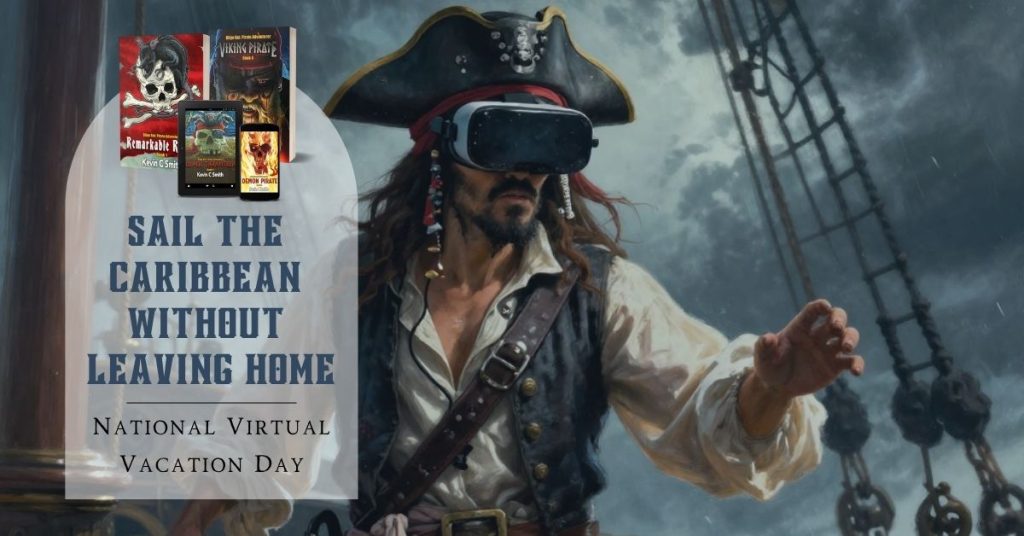
National Virtual Vacation Day: Sail the Caribbean Without Leaving Home

Explore real pirate locations, immerse yourself in history, and travel through story from wherever you are

Not every journey requires a ship.

On National Virtual Vacation Day, the idea is simple: explore the world without leaving it. No flights to book, no bags to pack, no schedules to follow—just curiosity, imagination, and a willingness to step into a different place and time.

And there may be no better way to take a virtual vacation than by stepping into the world of a story.

The Bilge Rat Series offers exactly that—a historically grounded journey through the Caribbean during the Golden Age of Piracy, where real-world locations become the stage for survival, strategy, and adventure. These aren’t imagined lands—they are real islands, real ports, and real waters that shaped one of the most dangerous eras in maritime history.

Today, you can visit those places—without ever leaving your chair.


What Is a Virtual Vacation?

A virtual vacation is more than simply looking at pictures online. It is about immersing yourself in a place—understanding its geography, its history, and the feeling of what it might be like to stand there.

With modern tools, you can:

  • Explore coastlines and islands using Google Earth
  • Watch immersive walking tours and drone footage
  • Study historical maps of trade routes and pirate activity
  • Read stories grounded in real-world locations

What makes a virtual vacation powerful is the combination of these elements. When you pair visual exploration with storytelling, the experience becomes layered.

You don’t just see the place.
You begin to understand it.

And when you read a story set in that environment—especially one grounded in historical pirate fiction—you begin to feel it.

The wind.
The tension.
The uncertainty.

That is when a virtual vacation becomes something more than passive—it becomes experiential.


Port Royal, Jamaica — The Pirate Capital of the Caribbean

Few places in the Caribbean carry the same legendary weight as Port Royal.

Once known as the “wickedest city on Earth,” Port Royal was one of the most infamous pirate hubs in history. During the late 1600s and early 1700s, it served as a gathering point for pirates, privateers, merchants, and naval forces.

This was a place where fortunes were made—and lost—quickly. Taverns lined the streets. Ships crowded the harbor. Deals were struck in the open, and danger was never far away. Port Royal was not just a port—it was a living system of commerce, crime, and opportunity.

Today, much of the original city lies beneath the water due to a devastating earthquake in 1692. This only adds to its mystique. Through virtual tours and historical reconstructions, you can explore both the modern coastline and the submerged remnants of what once was.

When you view Port Royal virtually, imagine:

  • The noise of the harbor
  • The tension between rival crews
  • The constant movement of ships and goods

This is the kind of environment that shaped the world of the Bilge Rat Series.

Tortuga — A Haven for Pirates

Just off the coast of Haiti lies Tortuga—a name that has become almost synonymous with piracy itself.

Tortuga was a strategic stronghold, valued for its defensible geography and its proximity to major trade routes. It was a place where pirates could regroup, repair ships, divide plunder, and plan their next moves.

But it was also a place of instability.

Alliances shifted quickly. Power was rarely secure. Trust was limited.

In the context of Golden Age of Piracy locations, Tortuga represents the raw, unregulated side of the pirate world—where freedom and danger existed side by side.

Exploring Tortuga virtually allows you to see:

  • The rugged coastline that made it defensible
  • The isolation that made it appealing to outlaws
  • The strategic position that made it valuable

It becomes easier to understand why it played such a central role in pirate history—and how environments like this influenced the behavior and decisions of those who lived there.

Guadeloupe — Structure, Wealth, and Power

Guadeloupe offers a different perspective on the Caribbean during the age of piracy.

While places like Tortuga represented chaos, Guadeloupe represented structure.

As a French colony, it was part of a larger economic system built on trade and production. Ships traveled to and from its ports carrying valuable goods such as sugar, rum, and spices—making it a key node in the Caribbean trade network.

For pirates, these structured systems were targets. They represented wealth, predictability, and opportunity. When you explore Guadeloupe virtually, you begin to see the contrast:

  • Organized towns and ports
  • Established trade routes
  • A sense of order and authority

This contrast is essential to understanding the world of piracy. Pirates did not exist in isolation—they existed in opposition to systems like these.

The Caribbean Sea — The True Stage of the Story

While the islands are important, the true setting of the Bilge Rat Series—and of pirate history—is the Caribbean Sea itself.

This vast expanse connected everything.

It was:

  • A network of trade routes linking continents
  • A battleground between competing empires
  • A hunting ground for pirates seeking opportunity

But it was also unpredictable.

Weather could change without warning. Visibility could drop in an instant. Ships could appear—or disappear—on the horizon with little notice.

Using digital tools, you can trace these routes and begin to understand:

  • The distances ships traveled
  • The risks involved in navigation
  • The isolation sailors experienced

This perspective adds depth to both history and storytelling.

How to Take Your Own Virtual Pirate Journey

Creating your own virtual vacation is simple—and surprisingly powerful.

Step 1: Choose a Location

Start with Port Royal, Tortuga, or Guadeloupe.

Step 2: Explore Digitally

Use tools like Google Earth, YouTube, and historical maps to understand the environment.

Step 3: Read Along

Open the Bilge Rat Series Kindle Compendium and follow the story as it moves through similar settings.

Step 4: Engage Your Imagination

Ask yourself:

  • What would this place feel like at sea level?
  • What dangers might be present?
  • How would you respond in that environment?

This process turns passive reading into active exploration.


⚓ Why This Kind of Travel Matters

Virtual travel is more than convenience—it is accessibility.

It allows people to:

  • Learn about history in a meaningful way
  • Experience distant locations without barriers
  • Connect storytelling with real-world geography

For educators, readers, and curious explorers, it creates an opportunity to engage with content on multiple levels.


🌅 A Different Kind of Escape

On National Virtual Vacation Day, you don’t need a passport.

You don’t need a plan.

You just need curiosity—and a willingness to step into something new.

The Bilge Rat Series Kindle Compendium offers a complete journey through the Golden Age of Piracy, making it the perfect companion for a day of virtual exploration.

Because sometimes the best adventures…

are the ones you take without ever leaving home.

Travel Through Story: The Bilge Rat Experience

Travel Through Story: The Bilge Rat Experience

The Bilge Rat Series uses real-world geography to ground its narrative, allowing readers to experience the Caribbean not just as a setting—but as an environment shaped by danger, opportunity, and human behavior.

As you explore these locations virtually, the story provides:

  • Context for what life was like
  • Insight into how decisions were made
  • A sense of what it felt like to live in that world

You begin to connect place with experience.

And that connection makes the journey feel real.

Want to be the first to read Kevin C Smith's blog posts about the real hisotry of the pirates of our past? Sign up for the newsletter join us as we set sail exploring high seas - one pirate adventure at a time!

Scroll to Top