
Punishments and Pirate Justice: The Myths and the Truth
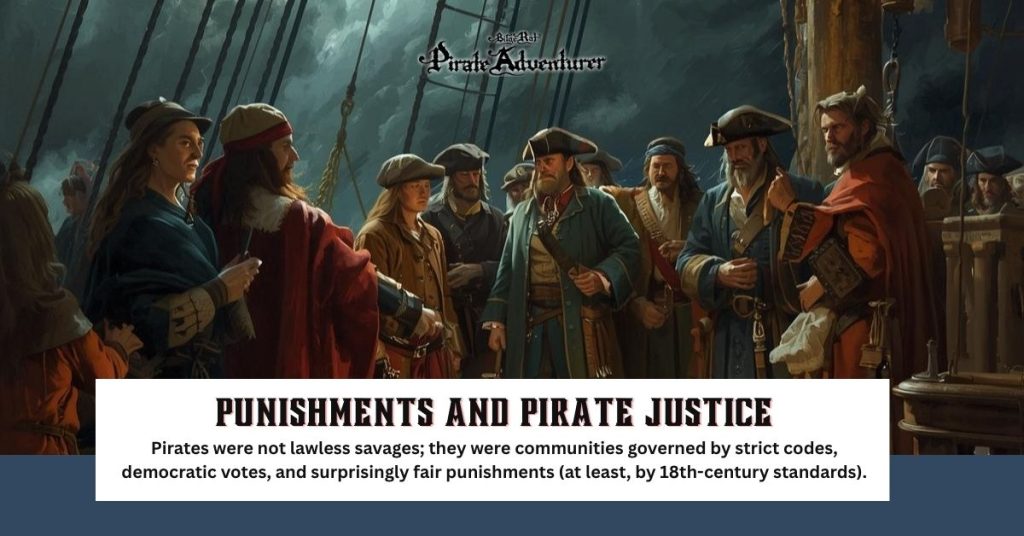
When most people imagine pirate justice, they think of walking the plank—a dramatic leap into shark-infested waters. But the truth, like much of pirate lore, is even more fascinating. Pirates were not lawless savages; they were communities governed by strict codes, democratic votes, and surprisingly fair punishments (at least, by 18th-century standards).
Still, the fear of mutiny and betrayal kept pirate discipline harsh. Whether through lashings, marooning, or the dreaded keelhauling, justice aboard ship was swift—and often final. In this post, we’ll separate the gruesome myths from the gritty truth about how pirates kept order on the high seas.
The Pirate Code: Law in a Lawless World
Every successful pirate crew lived by a written—or memorized—Pirate Code, a set of rules that governed behavior, loot sharing, and punishment. Far from chaos, these codes created structure and equality at sea.
Each crew voted to accept the code before sailing. Captains could be elected or deposed by vote, and punishments were decided collectively. Stealing from another crew member, desertion, or cowardice in battle were among the gravest offenses.
One of the most famous examples comes from Captain Bartholomew “Black Bart” Roberts, whose code dictated that anyone caught cheating at dice or stealing would be marooned with a pistol and a flask of water.
👉 Takeaway: Pirate democracy was harsh but practical—it kept men loyal, focused, and united.
Learn more:
Walking the Plank: The Myth That Wouldn’t Die
The most famous pirate punishment, “walking the plank,” appears more in fiction than in history. While there are rare accounts of forced drownings, the idea of making prisoners stroll off a wooden beam was likely invented by 19th-century writers to dramatize stories.
In reality, pirates preferred faster, more certain methods—like throwing captives overboard or shooting deserters.
Still, the myth persists because it perfectly captures the mix of fear, spectacle, and dark humor that defines pirate lore.
👉 Takeaway: “Walking the plank” may be false, but it symbolizes the psychological power pirates held over both their victims and their audience.
Learn more:
Want to be the first to read Kevin C Smith's blog posts about the real hisotry of the pirates of our past? Sign up for the newsletter join us as we set sail exploring high seas - one pirate adventure at a time!
Marooning: The Ultimate Pirate Punishment
To be marooned was to be left behind on a deserted island—sometimes with food and water, often without. It was one of the cruelest forms of punishment, reserved for mutineers or traitors.
Yet, some men survived. The most famous castaway, Alexander Selkirk, lived alone for four years on the Juan Fernández Islands after being marooned by his captain. His story inspired Daniel Defoe’s Robinson Crusoe.
Pirates used marooning both as punishment and psychological deterrent—a fate worse than death for anyone who betrayed their crew.
👉 Takeaway: Pirate punishment was isolation as justice—a grim metaphor for loyalty lost.
Learn more:
Keelhauling and the Cruel Edge of Discipline
Of all maritime punishments, keelhauling remains one of the most infamous. The condemned sailor was tied to a rope, dragged under the hull of the ship, and pulled up on the other side—his body scraping against barnacles and wood.
Though primarily a naval, not pirate, punishment, keelhauling became part of pirate legend. Few survived it, and even fewer forgot the screams of those who did.
👉 Takeaway: The brutality of seafaring punishment reflected both the dangers of mutiny and the ruthless logic of life at sea.
Learn more:
The Moral Code Beneath the Cruelty
For all their violence, pirates saw themselves as men of principle—bound not by kings or empires, but by their own version of justice. The Pirate Code created a unique moral framework where fairness, freedom, and fraternity mattered more than royal law.
In many ways, pirate society mirrored a floating republic: elected leaders, shared wealth, and the right to vote. Their “lawless” world, paradoxically, offered more equality than most nations of their time.
👉 Takeaway: Pirate justice wasn’t chaos—it was order born from necessity.

✨ Step into the world where legend meets history with the Bilge Rat Pirate Adventure Series
— a swashbuckling saga that blends the raw grit of historical detail with the timeless allure of folklore. From cursed islands and whispered superstitions to battles fought under blood-red skies, the series captures the thrill of life on the edge of the map while weaving in echoes of the myths that shaped seafaring culture. Perfect for readers who love historical fiction, nautical adventure, and the folklore of the sea, these tales invite you to escape into lawless frontiers and decide for yourself where history ends and legend begins.
FAQ
Q: Did pirates really have written laws?
Yes! Most crews created and signed articles of agreement before sailing, dictating shares, duties, and penalties.
Q: Was “walking the plank” ever real?
Very rarely. It was more of a theatrical invention than a historical practice.
Q: What crimes were punished most severely?
Mutiny, theft, or betrayal. Anything that endangered the ship or broke trust.
Q: Were pirate punishments fair?
By the standards of their time—yes. The Pirate Code applied equally to all, from captain to cabin boy.
Conclusion
Pirate justice was brutal, but it wasn’t mindless. Behind every lash and exile was a system designed to keep fragile order in a world of chaos. The myths of walking the plank or keelhauling pale beside the reality of pirate democracy—raw, dangerous, but surprisingly just.
⚓ To see these codes brought vividly to life, dive into the Bilge Rat Pirate Adventurer Series, where history, law, and loyalty clash on the high seas. Read more at Pirate-Tales.com.