
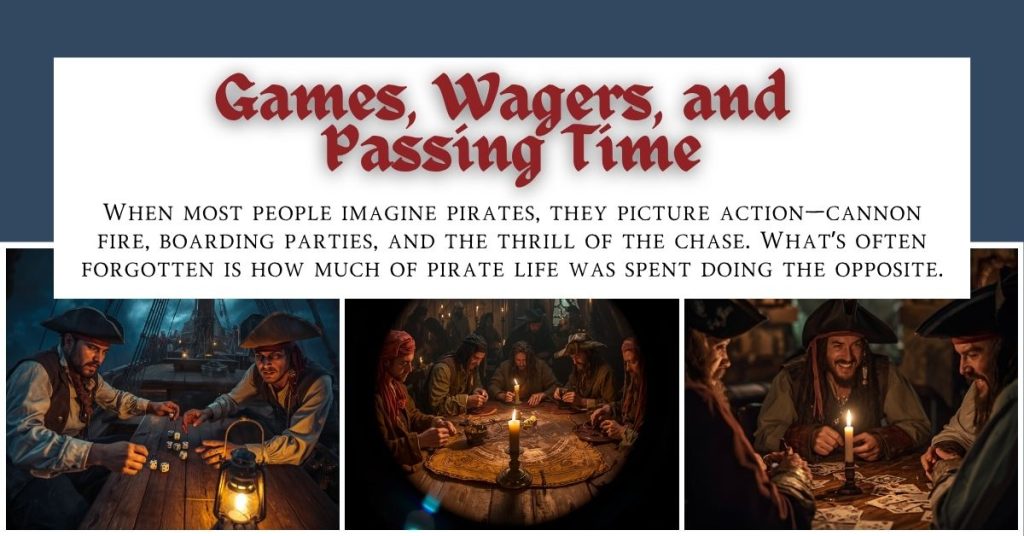
Games, Wagers, and Passing Time: Pirate Hobbies on the High Seas
Captain’s Log — Life, Distance, and Information on the Open Ocean
When most people imagine pirates, they picture action—cannon fire, boarding parties, and the thrill of the chase. What’s often forgotten is how much of pirate life was spent doing the opposite.
Waiting.
Waiting for wind to fill the sails.
Waiting for a ship to appear on the horizon.
Waiting out storms that could last days.
Waiting for something—anything—to break the monotony.
Life at sea was not a constant adventure. It was long stretches of repetition punctuated by moments of chaos. And in those long stretches, pirates did what people have always done when faced with time and confinement: they found ways to entertain themselves.
The result was a shipboard culture full of games, wagers, storytelling, and small rituals that helped transform boredom into something bearable—and sometimes even enjoyable.
Gambling: Risk Was the Point
If pirates had a favorite pastime, it was gambling.
This should come as no surprise. These were people who lived with risk every day. They chased it, depended on it, and sometimes survived because of it. Gambling simply brought that same thrill into their downtime.
Dice games were especially common. They required little space, minimal equipment, and could be played anywhere—from a barrel top to the deck itself. A handful of dice, a few coins, and suddenly a quiet afternoon could become a heated contest.
Card games were just as popular, offering a different kind of challenge. Where dice leaned on chance, cards introduced strategy, bluffing, and the careful reading of other players. A pirate who could read a man’s face across a table often had an advantage that extended far beyond the game.
Wagers weren’t limited to games, either. Pirates bet on everything—weather changes, how long a voyage would take, the outcome of a future encounter, even trivial daily events. When your life is unpredictable, even small outcomes feel worth wagering on.
Of course, gambling could lead to disputes. Many pirate crews established rules to limit excessive betting or to resolve conflicts before they escalated. Even in a world that thrived on risk, there had to be boundaries.
Still, the appeal was undeniable. Gambling turned waiting into anticipation, boredom into competition, and ordinary moments into something worth paying attention to.
Card Games: A Mirror of Pirate Life
Card games deserve special attention because they reflected the pirate mindset so well.
Games like Brag, an early ancestor of poker, rewarded not just luck but nerve. Success often depended on convincing others that your hand was stronger than it really was. It required confidence, deception, and a willingness to push your luck—all qualities that defined successful pirates.
Other games, like Whist or trick-taking games, required cooperation and strategy. These were not just individual contests but exercises in understanding others, anticipating moves, and working within a system.
In many ways, the card table was a smaller version of life at sea. Every decision carried risk. Every player had something to gain and something to lose. And sometimes, the boldest move was the one that paid off.
Want to be the first to read Kevin C Smith's blog posts about the real hisotry of the pirates of our past? Sign up for the newsletter join us as we set sail exploring high seas - one pirate adventure at a time!
Music and Shanties: Rhythm Against the Monotony
When the dice were set aside and the cards grew stale, pirates turned to music.
Sea shanties were more than entertainment. They were practical, rhythmic, and communal. The steady beat of a song could coordinate the pulling of ropes or the raising of sails. But beyond their function, they gave the crew something shared.
On long nights, when the sea stretched endlessly in every direction, voices carried across the deck. Songs told stories of past voyages, distant lands, lost loves, and exaggerated victories. Some were humorous, others haunting, but all served the same purpose: to break the silence.
Instruments were a luxury, but not unheard of. A fiddle, a drum, or a simple pipe could transform an ordinary evening into something memorable. Even without instruments, the human voice was enough.
Music created rhythm in a world that often felt uncertain. It gave structure to time and reminded the crew that they were not alone.
Storytelling: Building Legends in Real Time
If music gave pirates rhythm, storytelling gave them identity.
Pirates told stories constantly. Around dim lantern light or under open sky, tales were shared, repeated, and reshaped. A minor skirmish might become a legendary battle. A narrow escape might grow into a tale of impossible odds.
Storytelling served several purposes. It entertained, certainly, but it also educated. Younger or less experienced crew members learned from the experiences of others. They absorbed lessons about navigation, combat, and survival through narrative rather than instruction.
Stories also built reputation. A pirate’s legend could travel faster than any ship. By the time they reached a port, their reputation might already be waiting for them—larger than life and impossible to verify.
In this way, pirates didn’t just live history. They created it, one story at a time.
Training and Mock Combat: Practice with Purpose
Not all shipboard activities were leisurely.
Pirates understood that survival depended on readiness. Boarding another ship required coordination, speed, and skill. Combat was chaotic, and there was little room for hesitation.
To prepare, crews often engaged in mock combat and training exercises. Swordplay was practiced, movements refined, and techniques tested. These sessions could be serious, but they were also competitive. A friendly sparring match could quickly turn into a test of pride.
Training served as both preparation and release. It burned off energy, sharpened instincts, and reminded the crew of what they were capable of.

✨ Step into the world where legend meets history with the Bilge Rat Pirate Adventure Series
— a swashbuckling saga that blends the raw grit of historical detail with the timeless allure of folklore. From cursed islands and whispered superstitions to battles fought under blood-red skies, the series captures the thrill of life on the edge of the map while weaving in echoes of the myths that shaped seafaring culture. Perfect for readers who love historical fiction, nautical adventure, and the folklore of the sea, these tales invite you to escape into lawless frontiers and decide for yourself where history ends and legend begins.
Quiet Tasks: Small Moments of Control
Not every pirate sought excitement in their free time.
Some found comfort in quieter activities—mending clothing, repairing equipment, or carving small objects from wood. These tasks were practical, but they also offered something more: a sense of control.
Life at sea was unpredictable. Storms, battles, and changing conditions were beyond anyone’s control. But a repaired shirt, a maintained tool, or a finished carving was something tangible. Something completed.
These small acts provided stability in an otherwise unstable world.
Watching the Sea: Observation as Habit
Sometimes, doing nothing was its own activity.
Pirates spent long hours watching the sea. They observed the movement of waves, the behavior of birds, and the shifting patterns of clouds. What might appear idle was often anything but.
Observation was a skill. It helped predict weather, identify land, and recognize opportunities. It also offered a kind of quiet engagement—a way to remain present in the moment.
The sea itself became a source of endless variation. No two days were exactly the same, even when they felt like it.
Drinking and Social Life: Shared Experience
Alcohol, particularly rum, played a central role in pirate culture.
It was not just a drink but a social tool. It marked celebration, softened tension, and brought the crew together. After a successful raid or a narrow escape, a shared drink reinforced bonds that were essential for survival.
Like gambling, drinking had its risks. Too much could lead to conflict or poor judgment. Some pirate codes addressed this directly, setting limits or expectations for behavior.
But when managed, it contributed to a sense of camaraderie. In a life defined by uncertainty, shared moments of relaxation mattered.
Conflict and Competition: The Other Side of Entertainment
Where there are games, there is competition. And where there is competition, there is conflict.
Pirate ships were crowded environments. Personal space was nonexistent, and tensions could rise quickly. A disagreement over a game, a wager, or a perceived slight could escalate if left unchecked.
This is why pirate codes existed. They were not just about fairness in plunder but about maintaining order in a confined space.
Entertainment, then, was not just about passing time. It was part of the ship’s social structure—a way to build bonds, release tension, and manage conflict.
The Bilge Rat Perspective
In the Bilge Rat Pirate Series, life at sea is not reduced to action alone. The quieter moments—the waiting, the interactions, the games, the tension—are just as important.
It is in these moments that characters reveal who they are. Alliances form. Rivalries deepen. Decisions are shaped not just by external events but by the relationships built in the spaces between them.
The series reflects the reality that pirate life was as much about endurance as it was about adventure.
Conclusion: Life Between the Battles
Pirates were not constantly chasing treasure or fighting enemies.
They were living in a confined, unpredictable environment where time stretched and compressed in strange ways. In that environment, games and hobbies were not luxuries. They were necessities.
They provided structure, connection, and meaning.
They turned waiting into something bearable.
They turned strangers into a crew.
They turned moments into memories.
And in the end, those moments—quiet, competitive, creative, and shared—were just as much a part of pirate life as the battles that history remembers.